Tuesday, September 22, 2026

The Price of Being Watched

You are being watched, every day, every week, every second.

This week, I walked into my favorite class on communication-law, and ethics. The topic? An introspective look at how our privacy today is coming into question more and more; towing the line between what the government believes is ethical use, vs how those uses line up with morality.

Prior to the class, I believed already knew the basics of privacy law. Yet after a few hours of video lectures, I realized my knowledge hardly scratched the surface.

Flock cameras. A hot topic today, and a main focus of the lecture in class that day. These license plate readers are raising real Fourth and Fifth Amendment questions — unlawful search and seizure, and the right to due process, are both on the table. What bothered me though, was the scope: these systems collect where you go, what you're doing, and why you're there, even though the government has no explicit right to that information in the first place.

It is and has been a tension between security and surveillance that plays out at the federal level too, not just in local police departments.

As I recall, one video walked through how police departments are now logging every license plate that passes by, not just the plates connected to a crime. That means date, time, and location data on ordinary people going about ordinary days. 

There was a story about a man named Mike. Mike hadn't done anything wrong, yet hundreds of photos of his daily life sat in a database anyway, because storage is cheap now, so departments file the data away "just in case." In case of what? In case a man with no criminal record with a loving family in the suburbs goes rogue? In case he ends up tied to a drug cartel?

That "just in case" mentality turns into one massive, searchable database with near-infinite hits on where Americans are traveling. It's not hard to see how that could be misused. In one example, the NYPD reportedly used license plate readers near mosques to track who was visiting them.

Look anyone in the eyes and tell them that's a constitutional invasion of privacy. If you can, you're either wrong or a psychopath.

And yet, license plate readers are only one piece of the pie here. 


Cell tower dumps can show every phone that was using a specific tower at a specific time. Stingrays go a step further, sending out signals to detect which phones are inside which buildings. Police departments across the country hold a huge amount of this kind of surveillance footage and data, and the lecture I got this from was blunt about the risk: that much data sitting in one place gets abused. 

This may come as a surprise, but this isn't a new problem; the reporting on it goes back to at least 2015.

Something I appreciated from our lecture was the framing of this privacy crisis. It simply isn't a bipartisan issue. It isn't a Democrat or Republican problem, and even so, the diverse problem is too not reserved for "young people" either. It's a problem that affects you and me directly.

Here's the part that really got me thinking. If the government directly spies on citizens, that's a Fourth or Fifth Amendment claim waiting to happen. Yet if a private company, like Palantir as shown in our lecture that day, collects that same information, there's no constitutional violation. No violation of rights. No claim to be made, and all because the Constitution restrains government action, not private companies.

So what does the government do in such cases? How does the government grab that precious private information?

It simply buys or requests the data from the private company instead. That workaround is why media literacy now includes something as basic as being stingy with your own phone number and email.

Later on in the lecture, we covered "contracts of adhesion," -agreements where one party holds all the power. 

Every app's terms of service works this way. Once a company owns your data, it's theirs, subscription or no subscription. The case that stuck with me involved a lawsuit at Disney World, where a wrongful death suit was reportedly blocked because a Disney Plus subscription's terms of service contained a clause barring the person from suing. That single detail reframed how I think about clicking "I agree."

Our professor described data mining and behavioral tracking using an art metaphor: up close, a series of dots looks random, but stepping back, those same dots form a complete picture. That's a digital dossier. Facebook's data scandal was used as the clearest example, where the company could reportedly predict traits like gender, sexual orientation, and political affiliation with something in the range of 95 percent accuracy.

That's the "third-party doctrine" in action: once you hand information to a company voluntarily, you lose control over how it gets used downstream, sold, and resold. 

We can think of this via a term that came up towards the end of the lecture: "online tattoos." Facial recognition tools can pull thousands of records from a single photo almost instantly, and unlike a real tattoo, this kind of data doesn't fade. It outlives us, which is a strange kind of digital immortality nobody signed up for, yet everyone is bound to.

What tied the whole unit together, oddly, were the Greek myths. Sisyphus was mentioned, and he felt like a stand-in for reputation, something we're always pushing uphill and never fully control. Narcissus too was a warning against getting too absorbed in our own reflection, digital or otherwise.

The line that has stayed with me since class is a question posed and attributed to Jorge Luis Borges: "how else can you threaten someone other than with death?" The answer, apparently, is immortality. After a lecture of learning how permanent our digital footprint really is, that answer doesn't feel abstract anymore. It feels like the whole point.


A.I. Disclaimer: This post was made in collaboration with Claude. While the majority of the words and opinions written in this post are indeed my own, I asked Claude for help in order to format how I would go about writing each section...

Saturday, September 19, 2026

A Steady Descent from Dissent

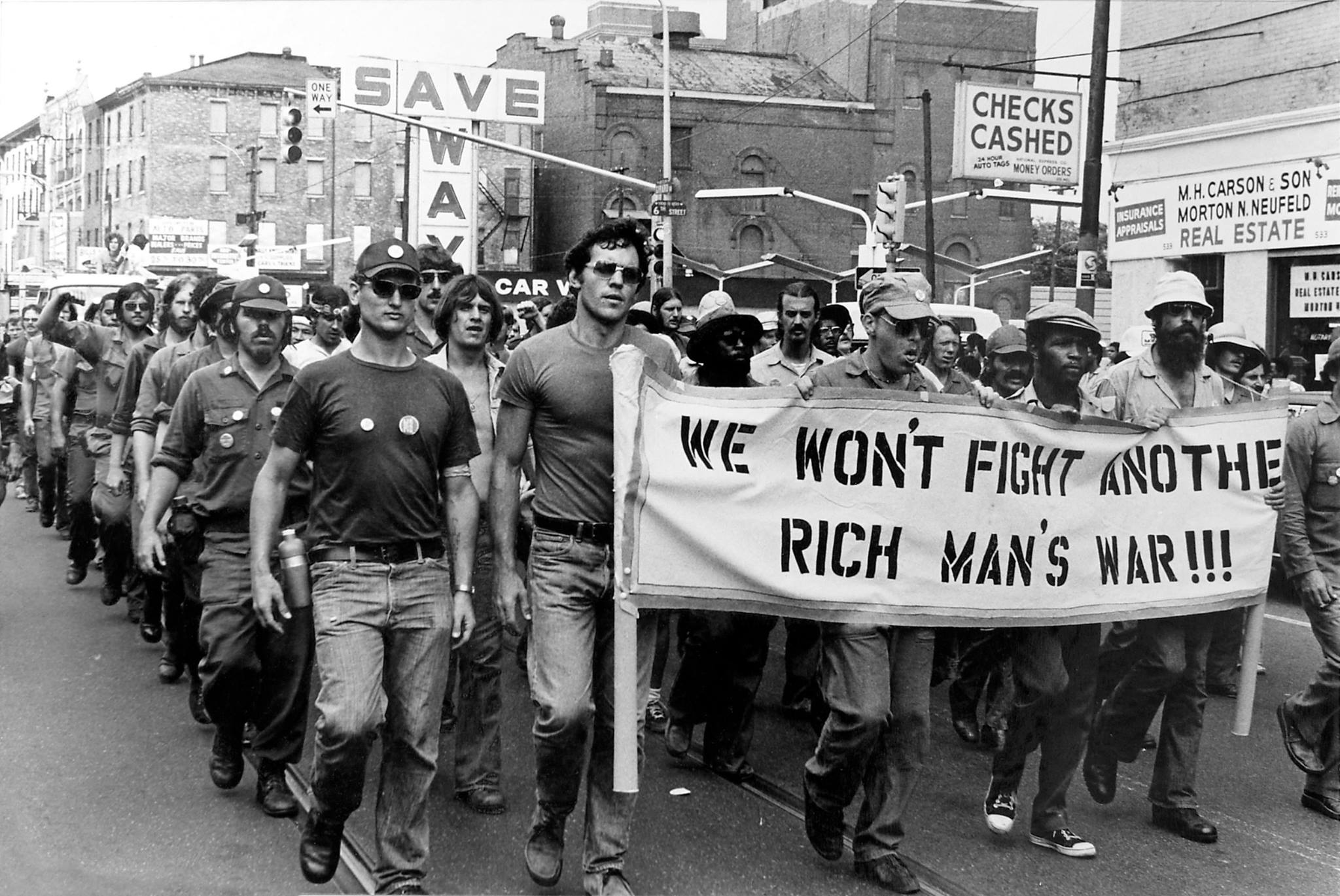
June 1, 1967: Vietnam Veterans Against the War Founded - Zinn Education  Project
Veterans protest the Vietnam War.


Democracy fails without protecting dissent.


“Criticism may not be agreeable, but it is necessary. It fulfills the same function as pain in the human body; it calls attention to the development of an unhealthy state of things. If it is heeded in time, danger may be averted; if it is suppressed, a fatal distemper may develop.” – Winston Churchill, 1939.


Ironic, isn’t it –to start off a post about a core value of free expression, here in the United States, with a quote from a leader across the pond in England? A man who, while speaking true in words, was nothing if not a hypocrite in actions.


Though regardless of the imperialistic views and hypocritical dichotomy of a man such as Churchill, he was certainly right in his quote that day. Criticism, while not agreeable, is absolutely necessary in maintaining freedom, liberty, and order, both demographically and ideologically; such is the idea of protecting dissent.


To protect dissent is something that is fundamental here in the United States. As a US citizen, you are not just allowed, but entitled to the ability to protest, criticize, condemn, or even denounce the government. What many fail to see about such a foundational value of free expression is that it isn’t a right, but a duty you owe not just to yourself, but to every fellow citizen around you. Without our voices we are nothing, and without our opinions, tyranny is inevitable.


Today however, we live in an age of suppression if nothing else. Voices and actions, ideas and values, all being wrongfully taken or restrained from us as United States citizens. As a nation, we do not have a perfect track record in following our own rules, yet that is exactly why we must speak out and criticize the government, to “redress grievances” in the first amendment’s own words.


It is not your place to lead if not a leader, but if you have the ability to use your voice in the many different forms it comes in, or suggest, criticize and correct, you must.


So where would we be without the protection of dissent? How would our country operate? Well the obvious answer is to look to the very country we broke away from 250 years ago. The exact aforementioned country in this article. A land of recently growing hypocrisy and injustice, and not by ideology, but by law.


In England today, people live their lives without any first amendment to protect them. They have no separation of church and state; no right to protest however you wish; and most importantly, no right to freedom of the press, nor a right to criticize the government.


As of this past year, England has hit a landmark in their descent into unprotected dissent. Daily, thirty or so citizens of England are being arrested and taken to local jails and prisons for comments they’ve made online. That’s nearly 12,000 people a year, all arrested for tweets, facebook posts, or the like.

Did these citizens riot? Attack? Threaten? Assault? No. That would be far too simple by England’s standards. Instead, these people have committed the unforgivable act of criticizing their lovely country; of inciting violence by calling their governors jackasses.


Some may see this article as inflammatory, and that’s perfectly fine, so long as you understand the message I intend to convey.


It is my opinion that England is and has been slipping into what I interpret as madness, not a fact. I understand that across the pond, they do not share the same constitution as we, nor the same freedoms and values. All the more, protecting those freedoms and values should be of utmost priority to all US citizens. If we do not continue to fight against injustice, speak out against war, and utilize our voices as Americans to their maximum capability, democracy will fail.

Tuesday, September 8, 2026

Sifting The Sands of News


News today is everywhere. It’s what we see when we wake up, what we scroll past when we get on our phone, and what everyone around you either hopes to, or fears seeing. It’s all encompassing and whether we like to admit it or not, it affects each and every one of us on a personal level.

Maybe news comes your way from television, or the newspaper, or the computers everyone today carries around in their pockets, but regardless of where, news will find you.

So in this flood of news that fills our screens, papers, and heads on a day-to-day basis, how are we to sort through it; to sift through the sands of words to find a grain that resonates with us personally? The answer is simple, that you must be the judge of what sources are meaningful enough to take a second glance at. In a world where a story that took place a week ago is ancient history, it can be relatively difficult to keep up. Today, I hope you can take away from my own experiences on how I do so personally, and that perhaps help yourself find news sources that mean something to you.


APPLE NEWS

As aforementioned in this article, in this day and age, for the most part, everyone around you carries what would only be considered witchcraft by generations past in their pockets; a smartphone. It’s a common belief that we don’t fully grasp the power a smartphone has, and that plays out no differently in looking at the news it brings you, right before your very eyes on a daily basis.

Where I live in America, there are two smartphones that dominate the market, being Apple and Android, with a large majority of the people I’ve met through my twenty one years of life carrying the former. However, what many don’t realize is that, by owning an iPhone by Apple, you inherently own one of the easiest accessible news sources in the modern day, Apple News.

Apple News is a fantastic place to go every morning when you wake up. It pulls from a variety of different outside sources of its own, and brings them to you in an orderly and unified manner.

Much akin to the various social media apps many use daily, Apple News picks up on trends that you show while browsing; whether it be top stories, political beliefs, or simply your interests and hobbies. Over time, as you use their platform, it gains an understanding of who you are and what you like, creating a customized feed that you are almost guaranteed to enjoy. It requires no subscription unless you want access to other major news corporation’s stories, in which case you’d be paying them directly on their own site regardless. I highly recommend it, and use it for most of my world-news updates in place of google’s top stories, which are unfortunately usually categorized by which company gives google the biggest payout.


YOUTUBE

Now, let's not overpraise a multibillion dollar cooperation too much, as it certainly has its flaws. For example, say I want more internet-style news in terms of what popular creators, artists, and scandals have gone on in the past week? Apple News certainly isn’t focused on such frivolities.

Instead, for internet-news, I turn my head to a platform which sucks up much of my free time when away from working or studying; Youtube.

Now, I’ll be the first to admit that the news Youtube provides certainly isn’t up to par with the other sources in this article. Simply put, it’s news for younger generations who care about internet dramas, stories, and history. Even so, it’s a helpful tool to use if you’re into that sort of thing, and provides an almost infinite array of creators and videos for you to browse until you find your niche.

Youtube is most certainly primarily a platform for entertainment, yet it undoubtedly proves itself as a useful catalog of a variety of different opinions on current events happening all around us.


INSTAGRAM


When thinking about a list of sources for this article, it almost pained me to add instagram as one of them. My relationship with instagram is shaky to say the least. On the one hand, I see it as a predatory app that creates a feed of content that it knows you’ll watch, and unlike Apple News, it does so with pure intent to keep you on their platform for as long as possible. On the other however, I will begrudgingly admit it’s a decent source of news depending on the person.

What I mean is that it is entirely up to you to manipulate instagram into the “news” platform you want it to be. Instagram uses a simple watchtime/follow rate algorithm to pick up on your interests. If you take the proper steps; following news-type creators, accounts that share news often, and watch them without distraction from other videos that seep into your feed, you’ll slowly create an app you can go to for a variety of sports, music, political, and other news.

It may sound hard, but aside from my main account on instagram, I also have a backup account where I’ve done exactly that.


ABC NEWS

If you’re a bit more old fashioned like myself and want to step away from the slog that is finding news on media platforms, why not get news from a direct source? ABC News is my favorite when it comes to official companies that deliver news articles by themselves.

As someone who doesn’t quite affiliate themselves with one political ideology or another, ABC News is right up my alley in terms of major news networks that deliver more raw facts than biases. 

The claim I make here is not without thorough research, and actually dates back to my high school years when I was in an AP Government class. There, I remember one of our assignments was simply to look at a well renowned media-bias chart. With this link you can access it, and see for yourself. 

The media-bias interactive chart is designed by, and created for those who want to know how much of their news is actually news beyond overhyping one side of the political spectrum or another. It works simply, with the x-axis being how far right or left a company leans, and the y-axis being how much of that company’s news is based on raw facts vs. opinions.

While I’m aware that ABC News does fall slightly left of the center, it is and has remained one of the few major news companies that is remotely close to the center of the political spectrum, and for that reason it is a source I find myself enjoying reading often.


USAFACTS

Following the trend of a lack of bias, I present to you usafacts.org, a website that is bar none the most fact based, unbiased, and unpolitical news source out there. My only reason for putting it so low on today’s list of sources, is that it is a rather boring website; yet boring does not constitute its usefulness.

Usafacts is a simple website that shows raw data and facts happening in America today. It does not lean either way whatsoever, and is certainly useful for big events.

I find myself only using this website when needing a statistic or news story that is hard to find an article on without bias. Other than that though, there isn’t much more to say on it. It’s raw data, and for that, I appreciate it.


With all that said, I genuinely hope you’ve enjoyed reading. Today’s article is certainly a matter of opinion rather than fact, yet I still hope you were able to take something away from it. News is a hard concept to fully grasp, and even the pros don’t have it down as much as they think they do. I wish the reader good luck with future endeavors concerning reliable, but more importantly enjoyable news sources.